
Prenatal Stress in Dogs: How the Mother Shapes Puppy Behaviour
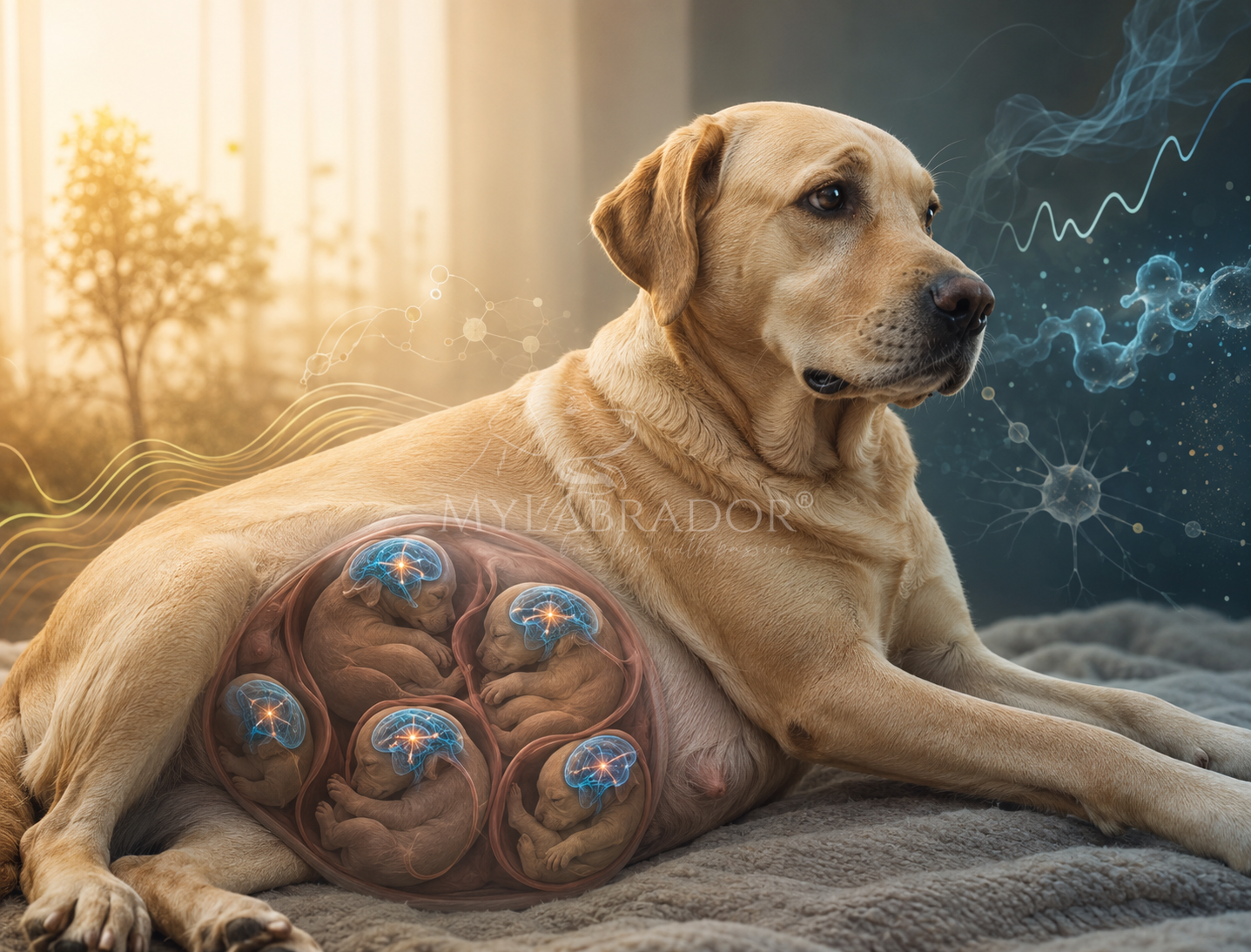
For a long time we thought of a dog’s behaviour as an almost entirely genetic matter: good genes, a balanced puppy; poor genes, a problem puppy.
Things are more complicated, and more interesting too. What happens in the mother’s womb, weeks before the puppy opens its eyes, can already start to write some pages of its future character.
This isn’t science fiction or armchair theory.
It is a field of research called DOHaD (Developmental Origins of Health and Disease), which grew out of studies on humans and other mammals and in recent years has begun to attract serious interest in the dog world too, especially in breeding working dogs, where emotional balance and the ability to concentrate make all the difference.
The HPA axis: the body’s stress thermostat
At the centre of it all is the hypothalamic-pituitary-adrenal axis, or HPA axis.
It works roughly like this: the hypothalamus sends a signal (CRH), the pituitary gland responds with ACTH, and the adrenal glands produce cortisol.
In dogs, cortisol is the stress hormone par excellence. In itself, cortisol is not the enemy: it mobilises energy, modulates the immune defences and prepares the body to face a real or perceived threat.
The problem arises when this response stays switched on for too long during pregnancy: the hormonal environment the foetus is exposed to can then change, and with it the processes that are building its nervous system.
Why the stage of pregnancy matters
One detail that often gets lost: it’s not only how much stress the mother goes through that matters, but also when.
The foetal brain passes through different developmental windows over the weeks of pregnancy, and the same amount of cortisol can have different effects depending on when it arrives.
The placenta protects, but it isn’t a fortress
There is an old, reassuring idea that the placenta completely shields the foetus from any change in the mother’s hormones. It isn’t that simple.
The placenta has an enzyme, 11β-hydroxysteroid dehydrogenase type 2 (11β-HSD2), which converts part of the active cortisol into cortisone, an inactive form.
It is a genuine biological filter. But, like every filter, it has a limited capacity.
If the mother’s stress is intense or goes on for a long time, this system can become saturated and let through more active cortisol than it should.
This doesn’t mean that every spike of stress in the mother harms the puppy.
A normal pregnancy always involves physiological hormonal changes, which are necessary and useful.
The documented negative effects concern mainly marked or prolonged exposure, not occasional moments of tension.
Epigenetics: the same genes, read differently
This is perhaps the most useful idea to take away.
Epigenetics doesn’t change DNA. It changes the way that DNA is “read” by the cell, through mechanisms such as DNA methylation, histone modifications and the action of non-coding RNA.
In practice, two puppies with the same genetic make-up can develop different stress regulation, different learning abilities and different emotional reactivity, depending on what they “experienced” in the womb.
It is a fine-tuning mechanism, not a mutation.
Above all, most of the direct evidence still comes from experimental models in other species: data on dogs do exist, but there are fewer of them and they should be interpreted with caution.
What this means in practice for a breeder
It doesn’t mean turning pregnancy into a sterile bubble with no stimulation at all. An environment completely free of challenges doesn’t prepare a puppy any better for real life.
Rather, it means avoiding chronic, intense stress: constant, pounding noise, conflict between bitches living together, frequent and unsettling moves, and neglected health care.
The difference is between an occasional stimulus and constant pressure that never lets up.
Why this matters most for working dogs
In the working Labrador Retriever, as in other working breeds, selection explicitly targets traits such as resilience to stress, a well-calibrated arousal threshold and the ability to stay focused in complex environments.
These are exactly the traits on which, according to the available literature, the prenatal environment may have an effect.
This takes nothing away from the value of genetic selection: strong bloodlines remain an essential starting point.
But it suggests that a serious breeder’s work doesn’t end with choosing the breeding pair.
It carries on, quietly, throughout the nine weeks of pregnancy.
What science really says, and what it doesn’t
To be honest, much of the strongest evidence comes from rodents, sheep and primates studied in the laboratory, where variables can be controlled in a way that is never possible in a real kennel.
Studies carried out directly on dogs are increasing but remain limited in number, and there is still a lack of large longitudinal studies following puppies from birth to adulthood.
This simply means that the practical advice should be taken as reasonable caution, not as rigid protocols based on absolute certainty.
The basic biology (the HPA axis, placental function, epigenetic mechanisms) is shared by mammals, and it is reasonable to think that it applies, with its nuances, to dogs too.
Frequently asked questions
Is stress during pregnancy bad for puppies?
Not automatically. Some stress during pregnancy is normal and physiological.
Problems arise only with intense, prolonged or repeated stress, and even then the outcome depends on genetics, how long the stress lasts and the stage of pregnancy.
How can I tell if my pregnant bitch is stressed?
Common signs are persistent loss of appetite, restlessness, sudden changes in social behaviour, difficulty resting and, in more marked cases, a disrupted sleep-wake rhythm.
If in doubt, talking to your vet remains the most reliable way to assess the situation.
Does epigenetics change the puppies’ DNA?
No. Epigenetics doesn’t alter the DNA sequence, but it can influence which genes are read and to what extent. It is a regulatory mechanism, not a genetic mutation.
Do these studies apply to all breeds?
Most of the available data comes from rodents, sheep and primates, with only a limited number of studies carried out specifically on dogs. The basic mechanisms are probably shared across species, but more longitudinal research on dogs is needed before drawing firm conclusions for individual breeds.
A puppy’s character isn’t born on the day it is whelped.
It begins to take shape earlier, in the hormonal and epigenetic environment its mother provides during pregnancy.
Looking after a pregnant bitch well, reducing chronic stress and giving her a stable environment, isn’t only about the mother’s wellbeing: it is already, in every sense, the first chapter of the puppy’s upbringing.
Want to learn more about caring for a pregnant bitch, or have questions about a particular puppy?
Contact us: we can help you assess the situation and put together a care plan tailored to your bitch and her litter.