Growth on a Natural Diet: Why Slower Is Healthier
Every now and then a worried message arrives: “My puppy is smaller than one from a friend’s litter. Am I doing something wrong?”.
In most cases the answer is no. Your puppy is simply growing at the right speed, while the other one is growing at the speed its food is forcing on it.
These are two different things, and the second is not the one to envy. It’s worth starting with what natural dog food really means.
A puppy shouldn’t grow as fast as possible
It’s a counter-intuitive idea for anyone used to thinking “the faster it grows, the better”.
In reality, in medium to large dogs, Labradors included, growth rate is one of the best-documented risk factors for developmental skeletal disease: hip dysplasia, elbow dysplasia and osteochondrosis.
It isn’t only what the puppy eats that matters, but also how quickly it turns that food into centimetres and kilos, racing through the main stages of puppy growth at the wrong speed.
A skeleton that lengthens quickly doesn’t have time to mineralise and remodel in a balanced way.
The growth cartilage is put under mechanical stress before it is ready to bear it.
You don’t see the result at two months. You see it at one year, when the dog struggles to go down the stairs or shows an intermittent lameness that owners find hard to link to the food it ate as a puppy.
How industrial extruded food speeds up growth
A high-energy kibble, with added fats and palatability enhancers sprayed on the surface, has two effects that add up: the puppy eats more of it because it tastes better than it should, and every gram it swallows carries more calories than it really needs at that stage.
The puppy isn’t regulating its food intake according to its real needs. It is responding to a product designed to be more palatable than necessary.
On top of this comes the question of bioavailability.
Many of the raw materials used in cheap kibble, such as low-quality meat meals and by-products treated at high temperatures, go through so much processing that part of the protein is denatured and the real absorption of amino acids and minerals is reduced.
On paper the puppy takes in plenty of calcium, but it absorbs an unpredictable share of it, often more than its bone metabolism can handle in that developmental window.
Excess calcium in large-breed puppies is a classic risk factor for skeletal abnormalities, not a guarantee of stronger bones.
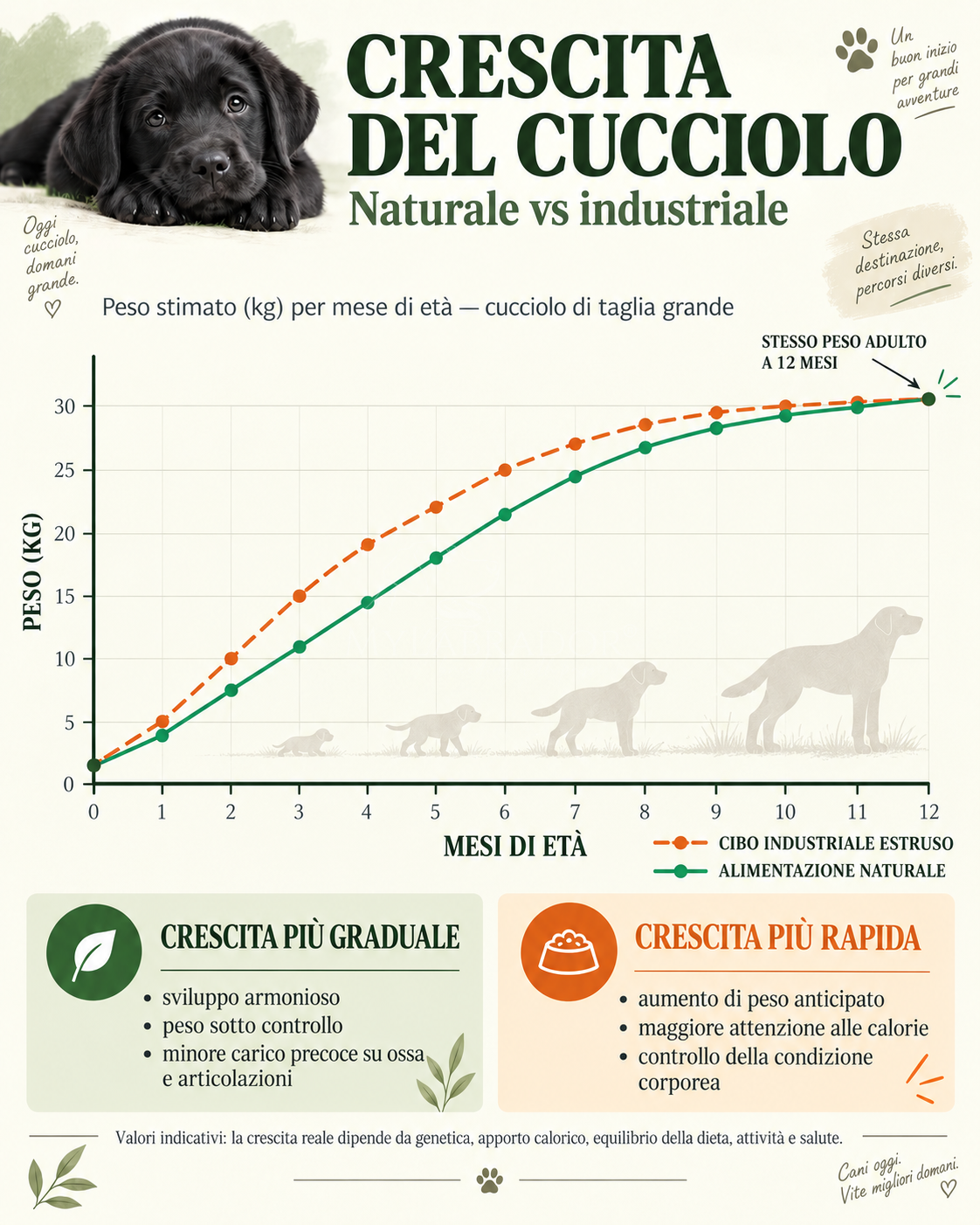
The net result is a puppy that puts on weight and lengthens quickly, with a growth curve that climbs steeply in the first months.
To owners it looks like a sign of good health. To the veterinary orthopaedic surgeons who see the consequences a few months later, it looks far less reassuring.
The damage, when it happens, is never just cosmetic or “a passing limp”.
Growth cartilage subjected to a load it isn’t ready to bear can suffer microfractures and faulty bone remodelling: this is the mechanism behind osteochondrosis and hip and elbow dysplasia.
In some dogs the outcome isn’t a minor problem that a few weeks’ rest will fix, but early-onset arthritis that stays with the dog for the rest of its life and, in the most serious cases, a real mobility disability that affects its quality of life and sometimes requires surgery.
It’s a high price to pay for having “pushed” growth in the first few months, and it’s no coincidence that one of the most common consequences in adults raised this way is a cruciate ligament injury or rupture.
Then there is a second front, less visible but just as real: the gut.
Low-quality raw materials, meals processed at high temperatures, too much refined starch and additives that a puppy’s digestive tract hasn’t evolved to handle all alter the make-up of the gut microbiome at exactly the time, the first weeks and months of life, when it is still forming.
A microbiome that settles in an unbalanced way at this stage tends to stay more fragile in adulthood: greater intestinal permeability, a less efficient immune response, and a predisposition to colitis, food intolerances and recurring skin problems.
Here too, what looks like a trivial “digestive” problem in a puppy can lay the foundations for weaknesses the dog carries with it for years.
When support is needed, targeted help on both fronts can come from supplements designed specifically for joints and cartilage and for rebalancing the gut flora. But they remain a support, not a fix for a diet that is wrong from the start.
What happens with a well-balanced natural diet
A natural diet, formulated by someone who knows the real needs of a growing puppy, has no palatability enhancers pushing it to eat more than it needs.
The raw materials, meat, fish, eggs and offal, are digestible, and the amino acids and minerals they contain are absorbed in more predictable proportions.
There is no gap between “what’s written on the label” and “what the body actually uses”, the gap that low-quality raw materials create.
The puppy eats according to its real hunger, not the artificial palatability of the product, and grows at a steadier pace.
The curve rises more gradually, without the sharp jumps typical of the first weaning phase on high-energy kibble.
On a chart it may look “behind” the average, but the reference average in many growth charts is built on dogs fed commercial kibble. Comparing yourself with that average means comparing yourself with the wrong standard.
Slower doesn’t mean smaller as an adult
This is the point that causes owners the most anxiety, so it’s worth being clear: slowing the growth curve in the first months does not reduce the dog’s final size.
A dog’s size potential is written in its DNA, not in how fast it gets there.
A Labrador that grows more slowly in its first six months still reaches its adult size, just with a skeleton that has had time to develop more soundly along the way.
The veterinary literature on large-breed dogs, from Hedhammar’s classic work on feeding levels to later studies comparing free-fed and rationed groups, points the same way: dogs fed with controlled calorie restriction during growth show a lower incidence of hip dysplasia and joint problems, for the same adult size reached.
The same principle underpins the WSAVA Global Nutrition Guidelines, the international reference for the veterinary nutrition of growing dogs.
How to tell if your puppy is growing well
Weight on its own says little. What matters is the trend over time and body condition. A few practical pointers:
- Weigh your puppy every week, always at the same time of day, and write the figures down: what matters is the trend, not any single number.
- Check body condition by feeling: you should be able to feel the ribs under a thin layer of fat, without having to press hard to find them, but without them being visible.
- A large-breed puppy that grows too fast tends to look “stocky”, with legs that struggle to keep up with the body: this is a sign not to ignore.
- If in doubt, a vet check with X-rays at key stages of growth is worth more than any weight chart found online.
The role of whoever formulates the diet
This is where the real difference lies between “feeding” and “nourishing”. A natural diet for a puppy must be calibrated to its month of growth, its expected adult size and the calcium-to-phosphorus ratio, not left to the dog’s appetite or copied from a generic recipe found online.
Done properly, it isn’t slower because it’s “deficient”. It’s slower because it respects the biological timing of the skeleton instead of forcing it with excess calories and palatability.
Frequently asked questions
Is my puppy on a natural diet underweight compared with breed standards?
Almost always not. The most widely used reference charts are based on dogs fed high-calorie commercial kibble, so they tend to present accelerated growth as if it were the norm.
The right measure isn’t a comparison with that chart, but a steady weight trend over time and body condition assessed by your vet.
Does slowing growth reduce a dog’s adult size?
No. Adult size is determined by genetics.
More controlled growth changes how long the puppy takes to reach it, not the end result.
How do I know if my puppy’s natural diet is balanced?
The most reliable way is to have it formulated or checked by a veterinary nutritionist who takes into account age, expected adult size and the calcium-to-phosphorus ratio, and to monitor weight and body condition over time with regular check-ups.
Worried about your puppy’s growth, or want to set up a truly balanced natural diet?
Contact us for a personalised nutrition consultation: together we’ll look at the growth curve, body condition and the feeding plan best suited to your dog’s size and age.